
Which moment was yours
Pick the problem that sounds most like your house
Eight problems, eight honest answers
None of these are parenting failures. They are what happens when the whole household plan lives in one head.
We are parents too. Every family we know has the same eight conversations on a loop, and most of them happen because the plan is invisible to everyone except the person holding it. Jepify moves the plan out of your head and onto your child's own screen, where they can act on it.
Tick the ones you hear yourself say. The page puts those answers first.
3 of 8 picked
Your picks stay on your screen. Nothing is sent anywhere.
Showing 3 picked problems first. The rest follow, because next month's problem is usually one of them.
NaggingSounds like you
I've asked you three times.
NaggingSounds like you
I've asked you three times.
The problem
The reminder is the job. You remember, you ask, you ask again, and by the third time it is no longer a reminder, it is a mood. Your child hears the tone and not the task, and you hear yourself and do not much like it either.
What changes
The task lives on your child's own phone, in their Your Day list, with a plain definition of done: bed made, floor clear, clothes in the basket, before dinner. Jepify sends the reminder at the time you agreed, so it arrives from the routine, not from you. You find out it is done because they tapped Done, not because you went and looked.
What your child learns
That a job can be theirs without an adult attached to it. Checking their own list is a small habit, and it is also the beginning of managing themselves, which is the thing you were trying to teach with the asking.
The invisible listSounds like you
Did anyone feed the cat?
The invisible listSounds like you
Did anyone feed the cat?
The problem
Someone in the house knows that PE kit is Wednesday, the cat is at five, the library book is overdue and the dentist is Thursday. Usually one someone. Nobody else can see the list, so nobody else can share it, and the person carrying it is the one who gets asked “did anyone…”.
What changes
Responsibilities and routines are written down once, in your family's own words, from templates or from scratch. Each one belongs to a named child and shows up on their screen. Your Home shows only what needs you today: a completion to check, a change request to answer. The rest runs without you holding it in your head.
What your child learns
That the household is a shared thing with visible parts, and that one of those parts is theirs. Children are surprisingly willing to own a job once it is theirs to see rather than yours to announce.
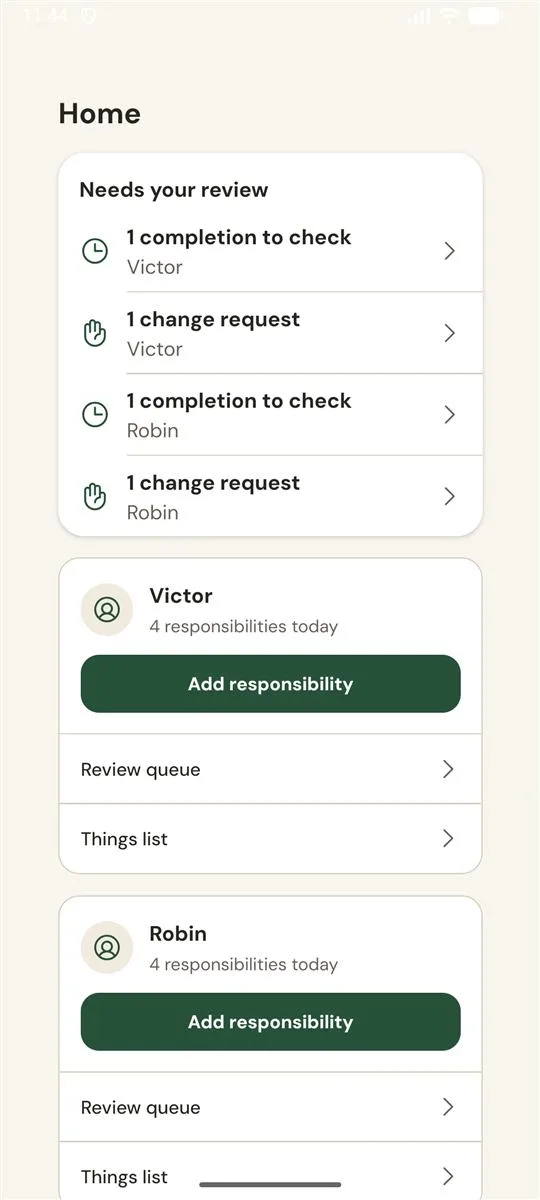
The parent view is deliberately short. It does not list every chore in the house; it lists what needs a decision from you: something to acknowledge, or a change your child is asking for. The list in your head becomes a queue you clear in a minute, usually with tea. Jepify Free covers one child and one guardian; a second guardian is part of Jepify Family.
Mornings and bedtimesSounds like you
Shoes. Now.
Mornings and bedtimesSounds like you
Shoes. Now.
The problem
Mornings and bedtimes are where ordinary days fall apart: the same eight steps every day, each one needing a prompt, with a clock running and a bus to catch. Nobody is at their best at 7.40, and the steps themselves are not hard. The hard part is that only you know what comes next.
What changes
A morning or bedtime routine becomes a short list of steps your child can follow on their own: dressed, breakfast, bag, shoes. Jepify shows the next step; your child moves through it and taps Done. You keep the clock. You stop being the script.
What your child learns
Sequencing: what comes next, and how to get through a routine without being steered through it. It is the same skill they will need for homework, revision and, eventually, getting themselves to work.

Start a routine at the Together level: you do it alongside them for a week and nobody pretends otherwise. The app does not expect a seven-year-old to run a morning alone. It expects the two of you to get there.
SiblingsAlso common
That's not fair.
SiblingsAlso common
That's not fair.
The problem
Siblings keep accounts. Who emptied the dishwasher last, who got away with it, who got more. Any system that lines children up against each other makes the accounting worse, not better, and a star chart on the fridge is a public scoreboard whether you meant it that way or not.
What changes
Each child has their own list, their own progress and their own Mission Levels, on their own device. There are no leaderboards, no sibling rankings and no streak punishment, by design. Fairness becomes you deciding what each child is ready for, and the app making that visible to that child, not to their brother.
What your child learns
That their progress is measured against their own last week, not against someone else's. That is where confidence without comparison comes from, and it is a habit of mind worth having long after the dishwasher.
Jepify Free covers one child. More than one child is part of Jepify Family (planned price €4.99 a month or €39.99 a year). Nothing is billed during early access.
Bribes and negotiationsAlso common
What do I get for it?
Bribes and negotiationsAlso common
What do I get for it?
The problem
A chore turns into a trade. Then the price goes up. Then the chore does not happen unless the price is paid, and you have accidentally built a small economy with one stroppy supplier. You did not set out to pay for teeth-brushing. It just happened, at bedtime, under pressure.
What changes
Rewards in Jepify are optional, and there is one simple model: a weekly allowance you both agree, the responsibilities it covers, and extra paid jobs or non-money rewards if you want them. Jepify never withholds allowance on its own, and a missed day never deducts money. The week is reviewed together: on track, or let's talk. Plenty of families use no money at all.
What your child learns
The difference between a responsibility and a job. Some things are done because you live here; some things can earn. Children are good at telling the two apart once the line is drawn in advance rather than argued at the sink.
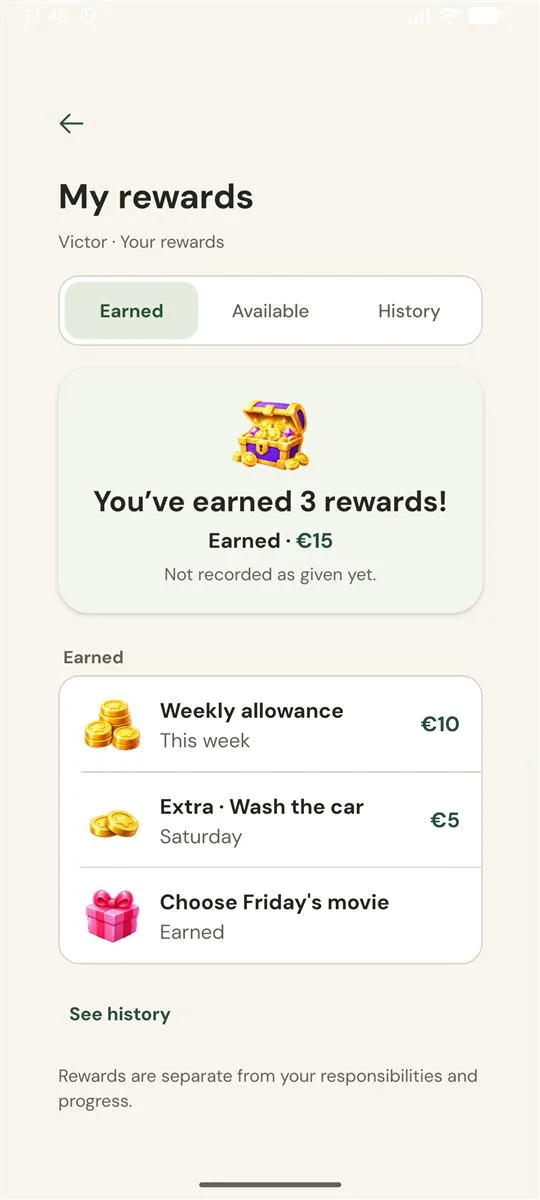
The child sees what they have earned and what is available, and nothing else. There is no shop, no points to spend in the app and nothing to buy. Rewards & allowance is a parent setting, and switching it off changes nothing else about the day.
Screen timeAlso common
Get off that thing.
Screen timeAlso common
Get off that thing.
The problem
You already worry about screens. Device overuse topped parents' list of concerns about children's health in the C.S. Mott Children's Hospital national poll in 2023. The last thing you want is one more app that wants your child's attention, dressed up as something good for them.
What changes
Jepify is screen-light. The screen shows what to do; the real work happens away from it: the bed, the bag, the bins. Open, tap Done, close. There are no feeds, no streaks to protect and no notifications designed to bring your child back. Jepify does not optimise for time in the app, and as a routine becomes reliable it should need less of your child's attention, not more.
What your child learns
That a phone can be a tool rather than a destination. It is a small lesson, and it is repeated every day in the only way that sticks: by example, on their own device.

What does happen on the screen is small and earned: confetti when a Mission is done, a Crown for the week, a gem for each level. Recognition for real work, then back to the real world.
Doing it yourselfAlso common
Fine, I'll do it myself.
Doing it yourselfAlso common
Fine, I'll do it myself.
The problem
It is faster. It is also how a nine-year-old becomes a fifteen-year-old who has never emptied a dishwasher. Doing it yourself is the most reasonable mistake in parenting, and everyone makes it, mostly at 7.40 and 8.15.
What changes
Every Mission has a support level: Together, Learning, Mostly Mine, I've Got This. You start where your child actually is and move up as the job becomes reliable. Jepify can suggest more ownership; you decide. Asking for help is taking part, and it never moves a level down.
What your child learns
Competence, in the plain sense: the experience of being trusted with something and managing it. That feeling does not come from being told they are capable. It comes from the dishwasher.
 TogetherYou do it side by side.
 LearningThey lead, you are nearby.
 Mostly MineThey run it, you check in.
 I've Got ThisIt is theirs. You confirm it.
Getting home on timeAlso common
Be home by eight.
Getting home on timeAlso common
Be home by eight.
The problem
Your child is old enough to walk home from practice or a friend's house, and you want them to. What you do not want is the 8.05 message that starts with "where are you?". So you either keep checking your phone or you keep saying no, and neither builds the independence you were hoping for.
What changes
You agree the time together: home by eight. A Home-by reminder reaches your child's phone before it, so they set off without being chased, and an arrival alert tells you when they are home. The agreement does the reminding, and you hear about it once, when it has been kept.
What your child learns
Keeping an agreement on their own, with the time in their own hands. It is the step between being collected and being trusted, and they can take it a little at a time.
Arrival alerts and the Home-by reminder are part of Jepify Family (planned price €4.99 a month or €39.99 a year). Nothing is billed during early access.
Your family's starting plan
What we would set up in your first week
Built from your picks above. Three Missions at most to start with; a family that begins with twelve usually ends with none.
For a house where you hear yourself say: nagging, the invisible list and mornings and bedtimes
- Room tidy, before dinnerOne job you ask about most. Definition of done written down. Reminder at the time you agree, from the app, not from you.
- Feed the cat, five o'clockThe job that only one adult ever remembers. Give it a name, an owner and a time, and take it out of your head.
- Morning routine: dressed, breakfast, bag, shoesFour steps as one routine. Your child follows the next step on their own screen; you keep the clock.
Leave rewards switched off for the first fortnight. Progress and acknowledgement carry a surprising amount on their own, and you can add an allowance later if your family wants one.
Start every Mission at Together or Learning, whichever is honest. Move a level up when the job has run reliably; help never moves one down.
Jepify Free covers all of this for one child and one guardian, with no expiry. You do not need Jepify Family for anything you picked.

Early access
Join the first Jepify families
We are inviting a small number of families to try Jepify before launch. Parents only; we never ask children for details. We will contact you directly when the next beta opens.
Jepify is for iPhone and Android, with the same core experience on both.
No payment details. No newsletter unless you ask for one.